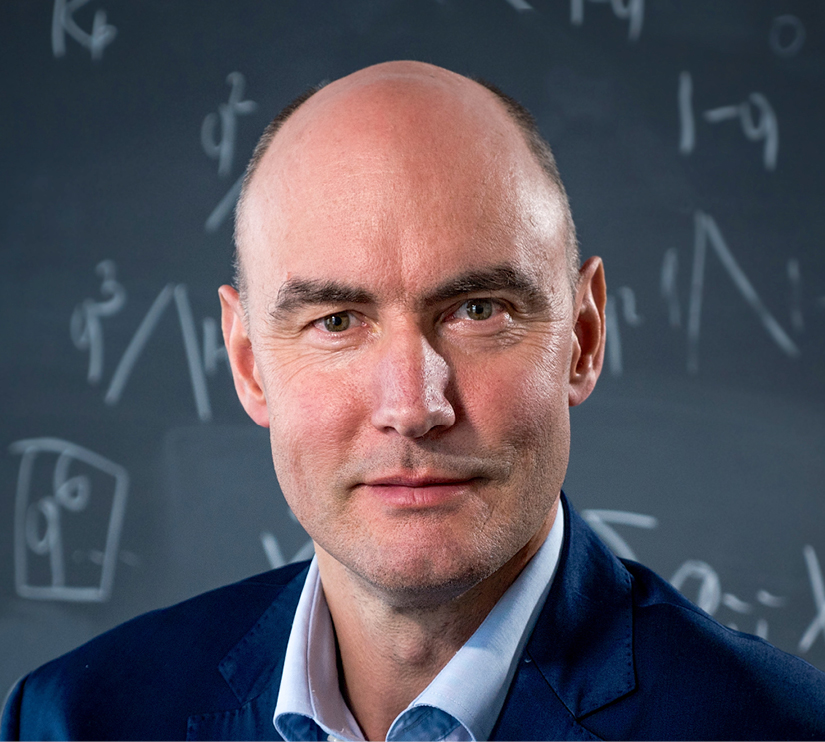
Martin Nowak
Harvard Professor of Mathematics and of Biology; former Director of the Program for Evolutionary Dynamics
Harvard professor of mathematics and biology who directed the Epstein-funded Program for Evolutionary Dynamics from 2003 to 2020. Epstein donated $6.5 million to establish the program in 2003 and kept visiting its offices after his 2008 conviction; Harvard sanctioned Nowak and closed the program in 2021.
Martin Nowak in the Epstein Files — By the Numbers
Topics Covered
Martin Nowak is a professor of mathematics and of biology at Harvard University. From 2003 until 2020 he was the founding director of the Program for Evolutionary Dynamics (PED), a research center established in 2003 with a $6.5 million donation from Jeffrey Epstein. Nowak’s long-running relationship with Epstein made him one of the most prominent academics implicated in the Epstein funding scandal, and in 2021 Harvard sanctioned him and closed the program.
Background
Born in Vienna in 1965, Nowak is a mathematical biologist whose work focuses on evolutionary dynamics — the mathematical principles that govern evolution, cooperation, and the behavior of complex biological systems. He earned his doctorate at the University of Vienna and held positions at the University of Oxford and the Institute for Advanced Study in Princeton before joining the Harvard faculty in 2003.
According to his Harvard faculty page, Nowak has written more than 500 papers and four books, including the textbook “Evolutionary Dynamics” (2006).
The Epstein-Funded Program for Evolutionary Dynamics
In 2003, Epstein donated $6.5 million to Harvard to establish the Program for Evolutionary Dynamics, with Nowak as its founding director. Harvard’s 2020 report and contemporaneous reporting describe it as by far the largest single gift Epstein made to the University; in total, Harvard’s report found Epstein gave the University $9,179,000 between 1998 and 2007 (the Harvard Crimson characterized the total as roughly $9.1 million given between 1998 and 2008). The program applied mathematical models to biological problems including cancer, infectious disease, and evolutionary theory.
After his 2008 conviction in Florida for soliciting a minor for prostitution, Epstein continued to visit the program. Harvard’s 2020 report found that Epstein “visited the offices of PED in Harvard Square more than 40 times between 2010 and 2018,” including six visits in 2018. The Harvard Crimson reported that PED gave Epstein keycard and passcode access and an office — Office 610, which staff called “Jeffrey’s Office” — and that the program maintained a Harvard telephone line identified as Epstein’s there until 2017.
Continued Contact After the 2008 Conviction
Harvard’s review concluded that Epstein “maintained a relationship with the director of the PED, Professor Martin Nowak, over the next 15 years, including after Epstein’s release from prison.” The report found that Epstein sought to use Harvard and the program to rehabilitate his public image after his conviction: at the request of Epstein’s publicist, the PED website was used to feature him favorably, and the Harvard Crimson reported that Nowak approved posting “flattering and false descriptions of Epstein’s philanthropy,” including his photograph, a biography, and links to Epstein’s own websites.
The review was commissioned by then-President Lawrence S. Bacow and carried out by Harvard’s Office of the General Counsel, led by Vice President and General Counsel Diane Lopez, together with the outside law firm Foley Hoag.
Administrative Leave and 2021 Sanctions
On the day the report was released in May 2020, the Faculty of Arts and Sciences placed Nowak on paid administrative leave. In March 2021, FAS Dean Claudine Gay announced sanctions, writing that she had “determined that sanctions are warranted” after concluding that Nowak had violated the FAS Professional Conduct Policy and policies concerning campus access, among others. Gay ordered the Program for Evolutionary Dynamics to be shut down “as soon as it is feasible,” with Nowak’s research absorbed by the mathematics department.
According to the Harvard Crimson and Boston.com, the sanctions barred Nowak for two years from serving as principal investigator on new grants or contracts and from taking on new advisees; he was required to co-advise existing graduate students and to have a co-leader on existing grants. He was permitted to continue teaching. Harvard restored Nowak’s advising and research privileges in March 2023.
In response to the 2021 sanctions, Nowak said, “I regret the connection I was part of … and the hurt that it has caused.” His attorney, Ellen J. Zucker, argued that “individuals, and not institutions, are too often left alone to take responsibility.”
Significance
Nowak’s case is one of the most direct examples of Epstein’s use of targeted academic funding to gain access and prestige. A $6.5 million gift to create a named research program gave Epstein a reason to visit campus, an office with keycard access, and a platform to present himself as a serious science philanthropist — access that persisted for years after a sex-crimes conviction. The episode illustrates the difficulty institutions faced in severing ties with a donor embedded in their intellectual infrastructure.
Documents
Primary-source records that reference Martin Nowak. Inclusion in these documents is not, by itself, evidence of wrongdoing; Nowak’s connection to Epstein was an academic-funding relationship, and he has not been accused of any crime.
- Giuffre v. Maxwell — unsealed court records (Jan. 2024) — Nowak is named once in the documents unsealed in this civil case (U.S. District Court, S.D.N.Y., No. 1:15-cv-07433). In a court filing, Alan Dershowitz lists “Martin Nowak” among “dozens of other academics and public figures who were associated with Mr. Epstein” — alongside names such as Larry Summers, Stephen Hawking, Steven Pinker, George Church and Richard Dawkins — as part of an argument that mere association with Epstein does not implicate a person. The mention concerns Epstein’s academic circle, not any allegation against Nowak.
Connections
View in network →People most often named alongside Martin Nowak in coverage, plus documented connections. Counts reflect shared articles, not verified relationships.
Show 1 more →
Sources
- Report Regarding Jeffrey Epstein's Connections to Harvard — Harvard University (Office of the President) →
- FAS Places Prof. Nowak On Leave After Report Finds Epstein Used His Program to Rehabilitate Image — Harvard Crimson →
- Harvard Asked Its Lawyers to Review the University's Ties to Jeffrey Epstein. Here's What They Found. — Harvard Crimson →
- Gay Levies Sanctions Against Prof. Nowak for Contacts With Jeffrey Epstein — Harvard Crimson →
- Harvard sanctions professor with close Jeffrey Epstein ties, closes program he ran — Boston.com →
- Martin Nowak — Harvard University faculty page →