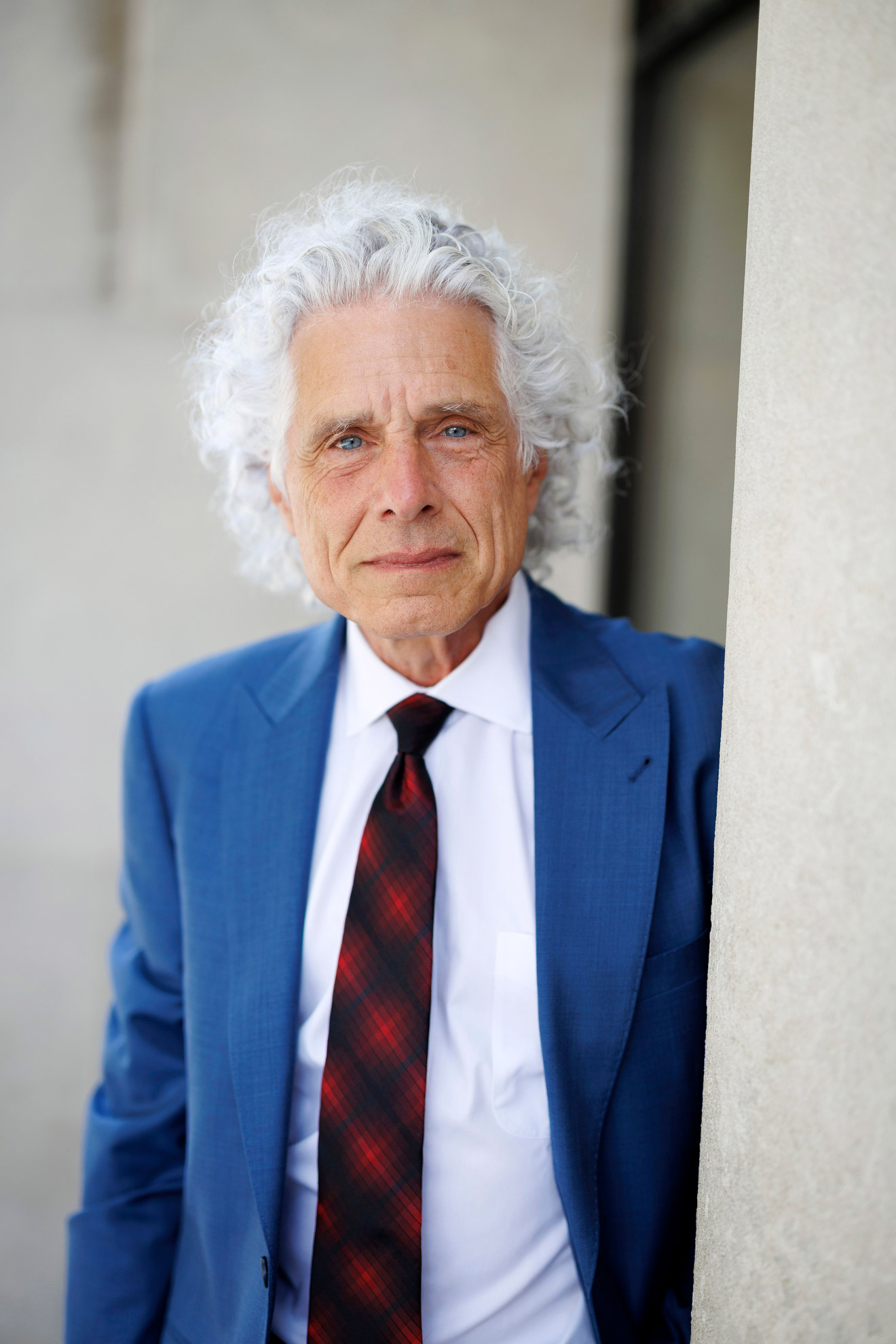
Steven Pinker
Harvard Cognitive Scientist and Author
Johnstone Family Professor of Psychology at Harvard University and bestselling author. Flew on Jeffrey Epstein's aircraft in 2002 and was later photographed near him, and in 2007 gave Alan Dershowitz a linguistic reading of a federal statute that was cited in Epstein's defense. Pinker says he regrets the letter and could never stand Epstein.
Steven Pinker in the Epstein Files — By the Numbers
Topics Covered
Steven Pinker is the Johnstone Family Professor of Psychology at Harvard University, a cognitive scientist, and a bestselling author of books including “The Language Instinct” (1994), “The Better Angels of Our Nature” (2011), and “Enlightenment Now” (2018). His circles overlapped with Jeffrey Epstein’s on a few occasions over the years, and in 2007 he gave a linguistic reading of a statute that was cited in Epstein’s criminal defense.
Background
Born in Montreal, Canada, in 1954, Pinker earned his PhD in experimental psychology from Harvard in 1979. He taught briefly at Stanford and then for many years at MIT before becoming the Johnstone Family Professor of Psychology at Harvard in 2003. He is one of the most widely recognized public intellectuals in the English-speaking world, known for his work on language, cognition, and the history of violence. Time magazine named him one of the 100 most influential people in the world in its 2004 list.
Connection to Epstein
Epstein cultivated extensive ties to Harvard, where, according to the university’s own 2020 review, he gave roughly $9.1 million between 1998 and 2008 — including a $6.5 million gift in 2003 to establish the Program for Evolutionary Dynamics — and visited that program’s offices more than 40 times between 2010 and 2018, after his 2008 conviction. The Harvard report does not name Pinker.
Pinker has said that he flew on Epstein’s plane once, in 2002, when his literary agent invited him to join a group of East Coast TED speakers Epstein flew to California; the trip predated Epstein’s first conviction. He has also said that in 2014 the physicist Lawrence Krauss seated him next to Epstein at a lunch where a photograph was taken.
In 2007, Pinker provided a linguistic analysis to Alan Dershowitz, his Harvard colleague and a member of Epstein’s defense team. At Dershowitz’s request, Pinker offered an interpretation of the wording of a federal statute on using a means of interstate commerce to entice a minor (18 U.S.C. § 2422). Dershowitz and co-counsel cited Pinker’s reading of the statute’s “plain meaning” in a July 2007 letter to federal prosecutors. Pinker has said he wrote the analysis as an unpaid professional favor to a colleague — “something that Alan and I do regularly” — that he was not aware at the time that the question pertained to Epstein’s case, and that, “knowing what I know now,” he regrets writing it.
Public Statements
Pinker has repeatedly distanced himself from Epstein. He has said he had no relationship with Epstein and never took funding from him: “I could never stand the guy, never took research funding from him and always tried to keep my distance.” He has described Epstein as “a kibitzer and a dilettante” whom he found “tedious and distasteful,” and said of the 2002 flight that he “immediately disliked Epstein and thought he was a dilettante and a smartass.” Of the 2007 letter, he said, “I did it as a favor to a friend and colleague, not as a paid expert witness, but I now regret that I did so,” adding, “I find Epstein’s behavior reprehensible.”
Context
Pinker’s case illustrates how Epstein moved through overlapping academic and literary circles — connections such as Dershowitz, the Harvard mathematician Martin Nowak, and the literary agent John Brockman repeatedly placed prominent scholars in proximity to him. A November 2025 review of released Epstein records by The Boston Globe found references to Pinker and his work but no direct written correspondence between Pinker and Epstein. Pinker’s involvement appears more peripheral than figures such as Nowak, who ran an Epstein-funded research program; being named in or near these records is not, by itself, evidence of wrongdoing.
Documents
Primary-source records that name or reference Steven Pinker. Inclusion in these documents is not, by itself, evidence of wrongdoing; Pinker has said he was not a friend of Epstein, was unaware of his crimes, and regrets the 2007 legal favor he provided.
- Giuffre v. Maxwell — unsealed court records (Jan. 2024) — Pinker is named in a declaration filed by Alan Dershowitz in this civil case (U.S. District Court, S.D.N.Y., No. 1:15-cv-07433). The declaration lists Pinker among academics “associated with Mr. Epstein” — alongside Lawrence Summers, Stephen Hawking, and Richard Dawkins — to argue that association with Epstein’s academic-funding circle is not, by itself, evidence of any wrongdoing.
- Epstein flight logs — Pilot manifests for Epstein’s aircraft, released by the DOJ in February 2025, record Pinker as a passenger on a single 2002 flight. Pinker has said his literary agent invited him to join a group of TED speakers Epstein flew to California, and that no one then knew of Epstein’s crimes.
Connections
View in network →People most often named alongside Steven Pinker in coverage, plus documented connections. Counts reflect shared articles, not verified relationships.
Show 1 more →
Sources
- How Jeffrey Epstein's Legal Defense Wound Up With A Linguistic Footnote From Steven Pinker — BuzzFeed News →
- Why Did Jeffrey Epstein Cultivate Famous Scientists? — Scientific American →
- Steven Pinker's aid in Jeffrey Epstein's legal defense renews criticism — Inside Higher Ed →
- Release of emails renews interest in Harvard professor Steven Pinker's link to Jeffrey Epstein — The Boston Globe →
- Report Regarding Jeffrey Epstein's Connections to Harvard — Harvard University →
- Harvard Asked Its Lawyers to Review the University's Ties to Jeffrey Epstein — The Harvard Crimson →
- Steven Pinker — Britannica →